
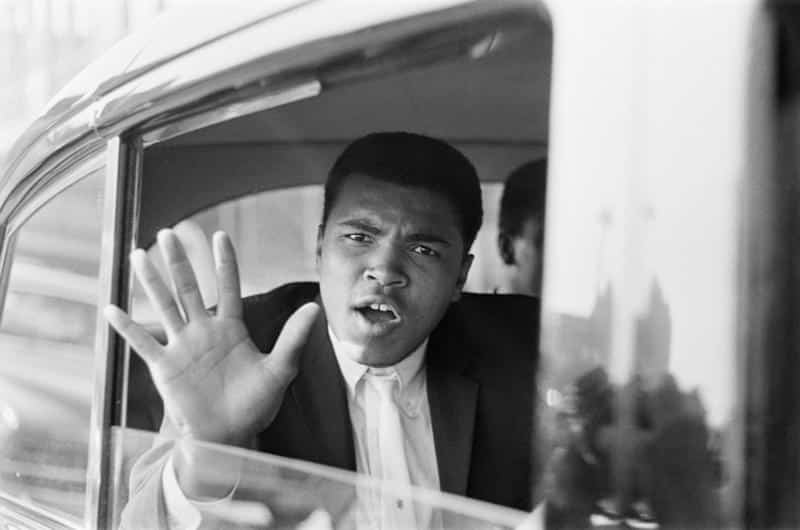
“Impossible is just a big word thrown around by small men who find it easier to live in the world they’ve been given than to explore the power they have to change it. Impossible is not a fact. It’s an opinion. Impossible is not a declaration. It’s a dare. Impossible is potential. Impossible is temporary. Impossible is nothing.”
– Muhammad Ali
A showman, a performer, a radical figure, a controversialist, a father, a philanthropist, a fighter. For years, Muhammad Ali has been an icon of superior interest in the sporting world and media alike.

“Champions aren’t made in gyms. Champions are made from something they have deep inside them-a desire, a dream, a vision. They have to have the skill, and the will. But the will must be stronger than the skill.”
– Muhammad Ali
Never before has there been or will there be a man like Ali, who captivated and inadvertently inspired the world with his stamina, his skill, his guile. He predicted his own future:
“I am the greatest, I said that even before I knew I was.”
– Muhammad Ali
He is The Greatest sportsman the world has ever seen.
Shop our Historic Newspapers book on Muhammad Ali to learn more about his life and work through newspaper headlines...

Cassius Clay Growing up In Jim Crow
Before he was known as Muhammad Ali, the greatest was born as Cassius Marcellus Clay; a dreamer of a child thwarted by anger one evening in 1954 at a local Louisville Home Show. He was victim to a robbery of his childhood red bike and sought out local police officer, Joe Martin who taught young Clay to channel his rage toward his future cause, boxing.
At 15 Cassius Clay won the gold medal at the 1960 Rome Olympics; met Gorgeous George in 1961 and fought the ruthless Sonny Liston in 1964 for the world heavyweight title. It was evident Clay was going to be a force to be reckoned with, not only with his fists, but in history.

“Now I had won the gold medal. But it didn’t mean anything, because I didn’t have the right color skin.”
– Muhammad Ali, The Soul of a Butterfly: Reflections on Life’s Journey
Limited Opportunities
Clay was considered a radical character for Americans; a talker – afraid of no man, vehemently verbose and exuding confidence. This was his appeal. He wasn’t phased, only fuelled to fight, especially from a young age. Clay was born in a time under Jim Crow, where state and local laws enforced racial segregation in the Southern United States, parading a ‘separate but equal’ guise for African Americans. These laws implemented an abundant difference on the conditions for the black community compared to the white privilege.

Clay was no stranger to discrimination – no one of colour was. Subject to racial prejudice from an early age, Cassius Clay encountered his fair share of unjust treatment and limitations if one was black. In his hometown of Louisville, after a hard tiresome day at work, Clay’s mother stopped off at a diner with her son for a glass of water. She was refused because of the colour of her skin. Clay experienced this prejudice himself when he was denied service at a segregated diner shortly after obtaining his gold medal. In response, he claimed to have tossed his medal in the Ohio River out of anger. Only later in his career, with great modesty, did Clay admit he’d in fact lost it.

“I know where I’m going and I know the truth, and I don’t have to be what you want me to be. I’m free to be what I want.”
– Muhammad Ali
In his career, Clay would be recognised as a symbol for black pride, representing not just one man, but an advocate for racial discrimination even in the most severe cases in history. Of all the racial prejudices Clay had encountered, it was the death of Emmett Till that had left its most poignant impact on young Cassius Clay.
In the early hours of August 28th 1955, Emmett Till, 14, went to visit family in Money, Mississippi; a neighbouring state under the rule of Jim Crow. Till bravely called a white cashier woman ‘baby’ during his visit, fuelling two men to act in a way the world would recognise forever. Two men turned up to the house where Emmett Till was staying and dragged him out of his bed and murdered him. Clay vividly remembered the event:
“Emmett Till and I were about the same age. A week after he was murdered, I stood on the corner with a gang of boys, looking at pictures of him in the Black newspapers and magazines. In one, he was laughing and happy. In the other, his head was swollen and bashed in, his eyes bulging out of their sockets and his mouth twisted and broken.”
The men threw his body in the Tallatatchie River for the world to see. In response to this heinous act, Till’s mother chose to have an open casket funeral to show the barbaric nature of the crime against her son and ultimately to anyone of colour who didn’t ‘know their place’. This was the moment that reaffirmed Clay’s realisation; the opportunities for a black kid in Southern America were fatally limited.
Ring Time
Clay was different to other boxers before and after him. He may have entered the ring as a black boxer, but he wasn’t there to entertain the white gaze or be controlled by mobsters like others before him. He was expected to be neutral; to maintain an inactive stance to the growing awareness of racial and political uprising. Instead, Ali generated great indignation from the White Citizens Councils, members of the National Association for the Advancement of Coloured People, for going against the grain. He would not be bound by structures society expected.

“The crowd did not dream when they laid down their money / that they would see a total eclipse of the Sonny.”
– Muhammad Ali
In Clay’s career, the only recorded time he ever truly felt scared, was during his match against Sonny Liston in February 02nd 1964. Bar the pre-fight badgering on both parts, Clay was fully aware of the brutality of Sonny’s reputation. Sonny Liston was someone Ali had never come across before.
Not only did Liston physically beat his opponents, he wounded them to the point of profuse humiliation. He was a character controlled by underground figures and no fool in the world of boxing. But, neither was Clay; he may have talked trash and beamed eccentric monologues before fights but there was a mastery behind this method.
In an interview with David Remnick of the New Yorker, Floyd Patterson, Clay’s 1972 opponent explained he was aware of Ali’s process of psyching himself up, “That’s why I always knew that all of Clay’s bragging was a way to convince himself that he could do what he said he’d do… It took me a long time to understand who Clay was talking to. Clay was talking to Clay. It reassured him he could do anything”.

“I figured that if I said it enough, I would convince the world that I really was the greatest.”
– Muhammad Ali
The Birth of Muhammad Ali
In 1964, shortly after Clay’s fight with Sonny Liston, Cassius Marcellus Clay rid himself of his ‘slave name’ and accepted a new title of Muhammad Ali. Clay’s interest in the Nation of Islam was not welcomed during his childhood in school, wanting to write a paper on Black Muslims and in return reprimanded from doing so by his English teacher. Since, his fascination with NOI was no longer a childhood fancy.
“I am America. I am the part you won’t recognize. But get
used to me. Black, confident, cocky; my name, not yours;
my religion, not yours; my goals, my own; get used to me.”
– Muhammad Ali
Speculation on the growing friendship between Clay and Nation of Islam’s member, Malcolm X sparked deep interest towards Clay’s beliefs as well as his position in boxing. Clay had been enamoured by X’s courage and power as a black man that spoke with such conviction. In a 1989 interview with Sam Pollard and Judy Richardson, Clay spoke reverently of his friend, “My first impression was how could a Black man talk about the government, White people, and be so bold and not be shot at?”

“Turning my back on Malcolm was one of the mistakes that I regret most in my life. I wish I’d been able to tell Malcolm I was sorry, that he was right about so many things. But he was killed before I got the chance. He was a visionary – ahead of us all.”
– Muhammad Ali
The public felt betrayed by Clay’s new affiliation and was not received well in the media. But in Malcolm X, Clay appeared to have found someone intertwined with his own beliefs, filled with such promise. Both men were intelligent, filled with youth, and intimidated white America. After Clay’s fight with Sonny Liston, the NOI made ther interests with Clay public. He then referred to himself as, Cassius X. For Malcolm X, the Nation had changed from the doctrine he had once believed. Malcolm X departed from the Nation of Islam shortly after Clay’s allegiance. With Clay’s acceptance of his new title from NOI’s leader Elijah Muhammad, it was clear Ali had made his choice and his largest regret.
Ali’s Legacy
After Muhammad Ali’s exile for refusing to fight in the Vietnam War in 1966, Ali brought with him a phenomenal comeback. The world was taken by storm the day Joe Fraizer beat Muhammad Ali in the ‘The Fight of the Century’ in 1971. It was Ali’s first ever professional loss, contributing to only five losses out of his whole career, and owning a staggering 56 wins.
“Joe Frazier’s a nice fella, he’s just doing a job. The bad talk wasn’t serious, just part of the buildup to the fight. The fight was serious, though. Joe spoke to me once or twice in the middle, told me I was burned out, that I’d have to quit dancing now. I told him I was gonna dance all night.”
– Muhammad Ali
It was evident even Ali’s competitors considered him as paramount, like George Foreman who has spoken of Ali with great admiration since there fight in ‘74, “I don’t call him the best boxer of all time, but he’s the greatest human being I ever met”.
Ali was made with immense confidence, speed and agility. His nimble movement to move back and avoid punches became legendary and contributed to his legacy, proving his gift as a boxer and a performer. An impressive presence, charismatic and enigmatic in person – he was a dreamer and knew how to bring those dreams to life. His technique was out of the ordinary, like a dance among giants he would toy with his opponent and much like a predator he circled his prey. He would not conform – he would not be oppressed – he would as it were, fight his corner even after retirement.
“It’s not bragging if you can back it up.”
– Muhammad Ali
There were two sides to the greatest. The world knew one while a handful of people knew the other. He was a man who lived in the moment – a fighter and a talker, with many nicknames attached to his personality and though Ali was inspired and motivated by other public figures, Sugar Ray Robinson, Gorgeous George, Malcolm X, Emmett Till – he was always himself, even in later life, harboured by an ill-fated affliction.
In memory of Muhammad Ali, Historic Newspapers has specially created a Muhammad Ali Newspaper History Book, paying homage to Ali’s incredible life and career.
As a charity Ali himself has funded, Historic will be donating £5 to Parkinson’s UK for every book purchased to commemorate ‘The Greatest’ sportsman in history and aid the charity in its pioneering work.
“I’m the greatest, I’m a bad man, and I’m pretty!”
– Muhammad Ali













Follow us