
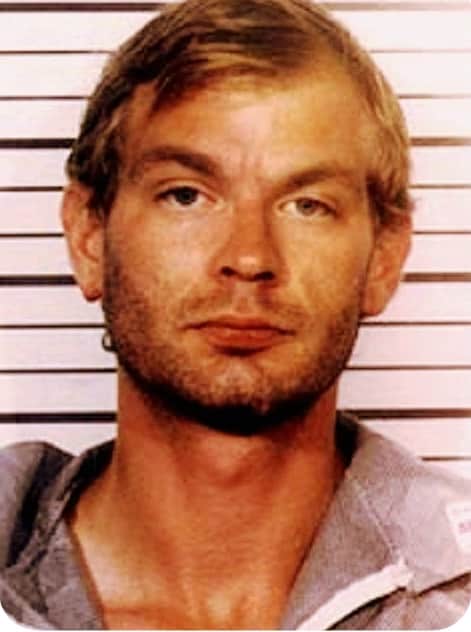
Jeffrey Lionel Dahmer hit the headlines in 1991 after confessing to the murder of seventeen young men in the states of Wisconsin and Ohio. Gone undetected for thirteen years, the details of Dahmer’s offences shocked the world following his capture, and led to a life sentence of at least 936 years in prison in 1992.
Ahead of the 30th anniversary of his sentencing, we reflect on the capture, conviction and death of the ‘Milwaukee Monster’, as well as the horrifying crimes he committed, through the newspapers that reported the story as it unravelled. These authentic Jeffrey Dahmer news articles offer a glimpse into the reactions of the press and the public as the details surrounding one of America’s most notorious serial killers first came to light.
Turn the page to:
- Who Was Jeffrey Dahmer?
- Dahmer Charged with Four Counts of Homicide
- “17 Killed, and a Life is Searched for Clues”
- “Dahmer: 936 years for ‘holocaust’”
- “Death of a Monster”
Who Was Jeffrey Dahmer?
Born in Milwaukee on May 21, 1960, Jeffrey Dahmer spent his school years as a gin-drinking outcast, ashamed of his secret sexuality, and harbouring an unhealthy obsession with the dissection of animals. Three weeks after his high school graduation and a month before the finalisation of his parents’ divorce, Dahmer strangled 18-year-old hitchhiker Steven Hicks to death with a barbell before dissecting and burying his body.
It would be nine years until Dahmer took his second victim, Steve Tuomi. Upon his capture, Dahmer would state that, while the first murder was unplanned, he had no recollection of the second whatsoever; nevertheless, Dahmer had disposed of Tuomi’s body in a suitcase. Over the next four years, Dahmer killed a further fifteen men in Wisconsin, including three in the space of a fortnight in July 1991. After what would most likely have been an eighteenth victim, Tracey Edwards, escaped and flagged down a passing police car, Dahmer was arrested. Police found various human remains and body parts hidden inside the apartment. During his interview, Dahmer willingly confessed to the murders.
After being declared sane at the time of all of the killings, Dahmer was charged with fifteen consecutive life sentences in February 1992, with a sixteenth (Hicks) added three months later. After two and a half years in prison, Dahmer was beaten to death by a fellow inmate on November 28, 1994.
Dahmer Charged with Four Counts of Homicide
On Friday, July 26, 1991, the Washington Post ran an article reporting the shocking potential extent of Jeffrey Dahmer’s killing spree. Though still months away from his trial, the seventeen murders attributed to Dahmer were by this point already assumed, following sixty hours of police interviews that ended with Dahmer’s confession:
“MILWAUKEE, July 25 – The convicted child molester whose apartment was strewn with body parts is believed to have killed at least 17 people, and he said he saved one victim’s heart ‘to eat later,’ authorities said today.”
The date of this particular Jeffrey Dahmer newspaper extract has extra significance as this was the day he was formally charged with, at this stage, four counts of homicide. It also mentions his molestation of Keison Sinthasomphone, a 13-year-old boy who managed to escape from Dahmer’s apartment, for which he served just under a year in prison:
“Dahmer, who is on probation for the 1988 sexual assault of a teenage boy, was formally charged today in Milwaukee County Circuit with four counts of first-degree intentional homicide and as a habitual criminal. Conviction on any of the homicide counts carries a mandatory sentence of life in prison. He was being held in lieu of $1 million bail.”
The article goes on to cover the nature of Dahmer’s capture, which occurred after Tracey Edwards, a 32-year-old man who had escaped Dahmer’s grasp by punching him in the face, led police officers back to the killer’s domicile:
“Police were led to the apartment Monday by Tracey Edwards, 32, who, although handcuffed, had escaped and flagged down officers. ‘He underestimated me,’ said Edwards, who said he met Dahmer at a mall and went back to the apartment for a beer. ‘God sent me there to take care of the situation.’”
Chillingly, the article ends by saying that the police had found in Dahmer’s apartment a photo of 14-year-old Konerak Sinthasomphone, the missing brother of the boy he had been convicted of molesting three years earlier:
“The boy’s brother, missing since May, is seen in the photo in his underwear, his handcuffed hands over his head, another brother said.”
Konerak Sinthasomphone would later be identified as the thirteenth of Dahmer’s seventeen victims.

“17 Killed, and a Life is Searched for Clues”
By late August 1991, Dahmer’s original charge of four murders had risen to fifteen. On 4 August, 1991, the Sunday edition of the New York Times scrutinised the life of Jeffrey Dahmer, attempting to come up with some answer as to how he could have ended up committing “one of the most horrific strings of slayings in modern times”:
“Mr. Dahmer drugged their drinks, strangled them and cut up their bodies with an electric buzz saw…”
“He discarded bones he did not want in a 57-gallon drum he had bought for just that purpose…”
“He lined up three skulls on a shelf in his apartment, but only after spraying them with gray paint, to fool people into thinking that they were plastic models…”
“He fried a victim’s bicep in vegetable shortening and ate it.”
The article begins with of a tale of how, as a senior in high-school, Dahmer had snuck into the honor society’s yearbook photo, just two months before murdering his first victim:
“One senior three rows from the top has no smile, no eyes, no face at all: his image was blacked out by a marker pen, reduced to a silhouette by an annoyed student editor… In all the years he cried out for attention, it was one of the few times he got caught.”
His former classmate, Martha Schmidt, would echo this portrait of a boy desperate to be seen:
“It seemed so clear all along that it was someone saying, ‘Pay attention to me’.”
From an early age, Dahmer exhibited a tendency to kill and keep small animals:
“Eric Tyson, who grew up across the street, said Jeffrey Dahmer kept chipmunk and squirrel skeletons in a backyard shed and had an animal burial ground at the side of the house, with graves and little crosses. ‘A number of neighbours have recalled seeing animals, like frogs and cats impaled, or staked to trees,’ he said.”
Other classmates interviewed remember Dahmer drinking gin and scotch in early-morning high school classes, as well as other eccentric behaviours:
“He sometimes tried to get attention by yelling odd exclamations in public places or by pretending to faint while crossing a street.”

Much of the article focuses on Dahmer’s “dysfunctional” family, a dynamic synonymous with other mass killers such as Ted Bundy and John Wayne Gacy, according to criminal psychologists. Dahmer apparently “felt neglected” following the birth of his brother David. Later, his parents’ marriage would unravel in front of him, with his father sleeping in a separate room and rigging it with an alarm to prevent his wife from entering. It was in the final weeks of their divorce in 1978 that Dahmer committed his first murder:
“Mr. Dahmer told the police he picked up a hitchhiker named Steven Hicks and took him home for a beer. Mr. Dahmer said they had sex. When Mr. Hicks wanted to leave, Mr. Dahmer smashed the back of his head with a barbell and strangled him.”
That first killing immediately set a pattern of disposing of his victim’s remains via methods borrowed from his childhood, methods which would see Dahmer meticulously evade capture for thirteen years:
“He dragged the body into a crawl space under the house, cut it into pieces and stored it in garbage bags. Later, he buried the bones, only to dig them up, crush them and scatter them in a ravine behind his parents’ house.”
After graduation, Dahmer spent just shy of three years in the U.S. military. He told police that after leaving the Army and moving to Milwaukee, he began having fantasies of killing people. His second murder took place in 1987, although Dahmer would always maintain that he was intoxicated and had no recollection of committing the act. For this reason, along with unsubstantial evidence, Dahmer was never charged with the actual murder of 24-year-old Steven Tuomi at the Ambassador Hotel, despite his subsequent actions upon waking up and discovering the body lying next to him:
“He told the police he left the body in the room while he went to a mall, bought a suitcase, returned to the hotel, put the body inside, called a taxi and took it to his grandmother’s house, where he was living. There he dismembered the body and disposed of it.”
From this point onwards, Dahmer’s executions would be unequivocally deliberate, as evidenced in the Times’ description of his third:
“He said that in 1989 he had sex with a man, drugged him and stabbed him with a hunting knife.”
And his fourth:
“His next killing, two months later, followed the same routine: sex, drugs in a drink, death and dismemberment. ‘Subject states he began getting quicker at cutting up the bodies,’ the police report noted.”
The article ends with an evaluation of Dahmer’s sessions with his parole-probation officer, Donna Chester, in the weeks leading up to his capture. Dahmer told Chester of being “uncomfortable with his family”, his financial troubles and “hating” people who make a lot of money, and his sexual orientation, which Chester claimed he felt “guilty” about. But ultimately, the hardships Jeffrey Dahmer was experiencing at the time of his arrest formed part of the tapestry of his life without pointing directly to the root of his malevolence. As the article states of Chester’s 81-page document on their sessions:
“Her impressions of Mr. Dahmer… give no indication that Mr. Dahmer set off alarm bells during their chats.”

“Dahmer: 936 years for ‘holocaust’”
After pleading guilty to his charges on January 13, 1992, a two-week trial took place to determine whether Jeffrey Dahmer suffered from a mental or personality disorder resulting in obsessions and impulses he was unable to control.
On February 15, the verdict was delivered, as reported by the New York Daily News:
“MILWAUKEE – Jeffrey Dahmer was sane when he killed and dismembered 15 men and boys in a horrifying quest for sexual gratification, a jury ruled yesterday.”
Ten of the twelve jurors believed that Dahmer “could have controlled himself”. District Attorney E. Michael McCann summarised:
“Dahmer knew at all times that what he was doing was wrong… This is not the case of a psychotic man.”
The verdict meant that Dahmer would be given a life sentence for each of the fifteen murders. Two days later, Dahmer was sentenced to a minimum 936 years in prison. The New York Post wrote:
“MILWAUKEE (AP) – Serial killer Jeffrey Dahmer was sentenced to life in prison without parole yesterday after telling a judge; ‘I take all the blame for what I did.’”
On the sentence, it continued:
“By sentencing Dahmer to 15 consecutive life terms, Milwaukee County Circuit Judge Laurence Gram effectively made it impossible for him to ever be eligible for parole.”
The judgement had been preceded by “hysterical” outbursts from relatives of Dahmer’s victims, with one, Rita Isbell, sister of the eleventh victim Errol Lindsey, needing to be restrained by bailiffs, as referenced in the Post’s sub-heading:
“Anguished sister of victim cries out: Killer is Satan”
USA Today noted that as the courtroom “exploded in emotion” Dahmer remained impassive, speaking in a “low monotone” as he acknowledged the families’ loss:
“Dahmer’s only sign of emotion: a deep breath he took before reading the statement he spent 4 ½ hours crafting in jail. ‘I deserve whatever I get for what I have done,’ Dahmer said. ‘I didn’t ever want freedom. Frankly, I wanted death.’”
“Death of a Monster”
On November 28, 1994, Jeffrey Dahmer was bludgeoned to death on the floor of the Columbia Correctional Institution gym by fellow inmate Christopher Scarver. As USA Today reported:
“He had extensive head injuries and a bloody broom handle was found nearby. Prison officials said his head could have been smashed against a wall. He died in hospital an hour after being found by guards.”
The front page of USA Today focused on the “relief” of Dahmer’s victims’ families, as well as neighbours’ conclusions that “he deserved it”. Their opening front-page paragraph read:
“Jeffrey Dahmer’s bloody death in a prison bathroom Monday was a dramatic – some say a fitting – end to the life of a killer and cannibal.”
The New York Post by contrast explored Dahmer’s fate from the viewpoint of the man himself:
“Jeffrey Dahmer – America’s most notorious serial killer – got what he felt he deserved yesterday when a fellow inmate bashed in his head in a Wisconsin prison bathroom.”
Both the Post and USA Today quoted Dahmer’s insanity trial lawyer Gerald Boyle to support this very notion:
“This is what I thought would come about three years ago when I represented him – that he would get killed in prison”.
“





















Follow us